

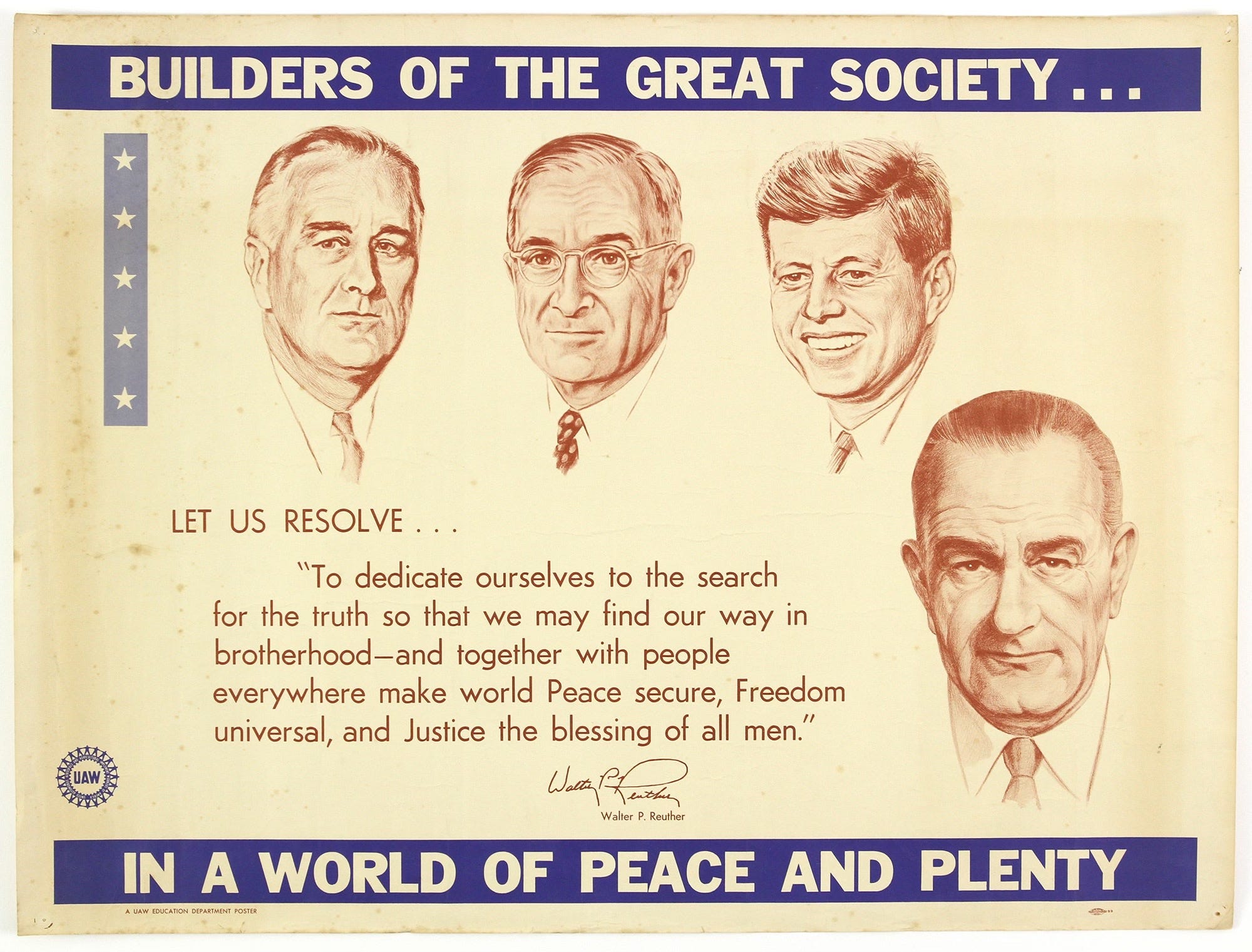
For starters, I have a little interpretive political history quiz for you to try :) There is no “right answer” and your vote is anonymous, so be honest!
Take a moment to read through the graphic pictured above. Which of the following statements comes closest to describing what you see?
Go with your gut reaction and choose the best available option:
A disturbing reminder of our harmful legacy of heteronormative white male supremacy and sexist language.
A poignant reminder of a time when the Democratic Party stood with the working class.
A stirring reminder of why we must continue to support Democrats in these perilous times.
An eye-rolling reminder of the many Big Government Democrats who did so much to mess up the country.
A curious reminder of a bygone era that, for better or worse, has little if any continued relevance today.
To avoid ambient peer pressure, results will be published separately in a forthcoming post. In the meantime, feel free to elaborate on why you chose what you did in the comments section below!
Why I Chose Door Number Two
Now that you’ve hopefully voted, I’ll share my thoughts FWIW.
There’s no question that my initial gut reaction to the above-pictured UAW poster from the 1960s corresponds best to Option 2: “A poignant reminder of a time when the Democratic Party stood with the working class.” Most simply, the reason for this is as follows:
On the one hand, I grew up in a very progressive Chicago suburb and was socialized to believe in the progressive liberal values of individual freedom, equal rights, nondiscrimination, and (old-school) social justice. On the other hand, through the course of my adulthood, I’ve seen the status and security and of the American working and middle classes erode tremendously. And at least as I see it, the Democratic Party played a central role in both.
The aspirational liberalism of my childhood was very much rooted in the Democrats’ New Deal and Great Society initiatives, along with the labor and civil rights movements they eventually came to champion. And for those that don’t know the history — these are exactly the same momentous historical developments represented by the UAW poster pictured above.
Fast forward to the present day, however, and I now see the Democratic Party as having co-presided (along with the GOP) over the hollowing out of status, stability, and security of the American working- and middle-classes during the course of the past half-century. Slowly but surely, this ongoing socioeconomic erosion undermined the foundation upon which all the progressive liberal achievements from the New Deal onwards must necessarily rest. As the solidity of the working- and middle-class that developed during the 1930s-60s was increasingly undercut from the late 1970s onwards, the legitimacy of the entire progressive liberal project deteriorated right along with it.
This divergence between the aspirational liberal vision the Democrats used to symbolize and the concrete disappointments of their actual track record is only one piece of the puzzle that has come together to create today’s crisis of liberalism, however. Because even though I never resonated with Reagan’s invocations of America as “a shining city upon a hill,” millions of Americans did. The resultant GOP track record also disappointed many who’d put their faith in that version of the American liberal dream. Today, countless conservatives who once shared the optimistic vision of the “Morning in America” ‘80s now share a parallel sense of dislocation, confusion, and loss with once-loyal Democrats like me.
That said, issues of socioeconomic equality are not the only ones that matter here. The full story is far more complicated than that. Still, there’s no question they’re fundamental. Plus, they’ve received far less attention than the culture war issues that have raged since the 1960s. Yet these cultural cleavages developed in tandem with the socioeconomic erosion of America’s working and middle class — and making that connection is important. Today’s twinned groundswell of right- and left-wing populism, with its two-pronged attack on both the cultural pretensions and the economic privileges of the status quo-serving elite, is solid evidence of that.
Defining “Liberalism”
“Liberalism” is a confusing word in an American context, as it can refer to several different things. So when I contend that American liberalism is in crisis, it’s worth taking a moment to clarify what, precisely, I mean.
Boiled it down to basics, the words “liberal” and “liberalism” are commonly used in three distinct, if interrelated ways in the U.S.:
In everyday parlance, the word “liberal” is often used interchangeably with “Democrat,” “progressive,” “leftist,” or even (as Trump would put it) “radical left-wing lunatic” (lol). Of course, such sloppy terminology tremendously frustrates serious politicos of all left-of-center stripes, as they’re in their own particularly named lane for a reason. (Formally speaking, for example, “liberal” and “left” should be seen as two separate categories.) Regardless, in today’s hyper-polarized climate, a huge range of often radically divergent centrist-to-left positions get thrown into the same “liberal” bucket. While this unfortunately makes for a very muddled political discourse, it’s also simply the way that it is.
Alternately, it’s become increasingly common to refer to the “bipartisan liberal consensus” of the post-World War II era, and claim that it’s now broken. The idea here is that from the 1940s until the mid-2010s, Democrats and Republicans worked within the same overarching liberal paradigm (even while they advocated for different positions and competed for power within it). If Democrats wanted to strengthen the welfare state and Republicans wanted to shrink it, for example, both remained loyal to the same underlying liberal principles and national touchstones. Once mostly confined to scholarly circles, this understanding of American liberalism has become much more widely used since Trump succeeded in smashing both parties’ taken-for-granteds in 2016.
Finally, the term “liberalism” also refers to a centuries-old political tradition rooted in the European Enlightenment that prioritizes the value of individual freedom. Other core liberal principles include the rule of law, civil rights and liberties, limited and representative government, a market-based economy, and freedom of speech, assembly, religion, and the press. Used in this sense, the larger liberal tradition contains many historically specific variants within it, including the laissez-faire liberalism of the 19th century, the New Deal liberalism of the 1930s-70s, and the neoliberalism of the 1980s-2010s. Despite such variation, liberalism is still seen as sufficiently coherent to represent a distinct — and hugely important — political tradition.
Given that the words “liberal” and “liberalism” are used in such different ways, what, precisely, does it mean to say that American liberalism is in crisis? Well, that depends. For some, it simply means that the Democratic Party is in bad shape. For others, it means that the entire postwar liberal consensus has broken down and that the old guard of both parties has been discredited. For still others, it means that the entire overarching tradition of liberalism as a longstanding political paradigm is in crisis — which is tantamount to saying that the entire modern world as we’ve known for hundreds of years is in crisis as well.
Personally, I believe that the first and second contentions are indisputable: Yes, the Democrats are a mess. Yes, the postwar liberal consensus has broken down. Not everyone may agree. But by this time, I see both as solidly established fact.
The third option, however — that liberalism writ large is in crisis — is a different matter. That issue is an exponentially bigger, more complicated, and more difficult one to address. That said, it’s certainly a question that not only bears asking, but taking quite seriously today.
If that conversation has started in scholarly circles, however, everyday political discussion has mostly gone in the opposite direction. Generally speaking, we’re stuck with a dumbed-down and over-simplified discourse, divided between two hyper-polarized camps whose main message is the urgency of defeating the other. True, each side contains some thoughtful voices, and there are plenty of excellent articles, podcasts, and books available online. Unfortunately, however, this remains the dominant pattern.
Liberalism in Crisis
If you’re looking for a more informed, nuanced, and accessible examination of what’s been happening and why, you should consider joining my upcoming “Liberalism in Crisis” mini-course. To make this work, I’m looking for a small number of subscribers (limit 10) who can meet on Zoom for a series of eight 90-minute weekly sessions. (Update: We’ve hit our 10-person limit for the mini-course, so enrollment is now closed. If you’d be interested in doing something similar in the future, though, please let me know.) The format will be a study/discussion group, meaning that everyone learns with and from each other, in conjunction with a shared set of readings and resources. In other words: No lectures, but no free-form political gripe sessions, either.
Ideally, this group will include a mix of ages, formal education levels, work experiences, political backgrounds and commitments, etc. The actual composition, however, will be left to luck of the draw. Everyone is welcome, provided you’re interested in learning with and from others, thinking into different perspectives, and willing to politely put up with views you don’t agree with (like a good old-fashioned liberal :).
Given today’s all-too-often unhinged social climate, participants must also respect everyone’s confidentiality. This means no discussing any identifiable individual in public, and no recording or screenshotting of any part of any meeting. While we won’t necessarily be discussing any super-dicey topics (focusing on history helps with that), everyone needs to feel confident they can speak freely. Anyone who causes any problems whatsoever on this front will be promptly banned from the group and blocked from this site.
The primary text we’ll use is The Rise and Fall of the Neoliberal Order: America and the World in the Free Market Era (Oxford University Press, 2022) by Gary Gerstle. I chose this book for several reasons. First, Gerstle is a highly respected scholar of American political history. Second, the book is nonetheless written for a general audience. Third, it covers U.S. history from the New Deal to the present in under 300 pages — which is long, but not impossible over the course of eight weeks (particularly as I’ll recommend cutting some of it out).
Finally, this book places its primary emphasis on socioeconomic developments that impacted everyday Americans from the New Deal onwards, which is historical territory that most of us only understand vaguely, if at all. We’re more familiar with the post-1960s culture war — which, while equally important, needs to be considered in conjunction with socioeconomic issues, rather than in isolation from them (which is how they’re usually framed). Given that Gerstle’s discussion of cultural politics is relatively skimpy, we’ll supplement his book with additional resources, along with our own personal experiences and background knowledge.
Key questions that the study/discussion group will focus on include:
What is liberalism, both theoretically and empirically? How has it been most influentially critiqued from both a left- and right-wing perspective?
What were key phases in the evolution of American liberalism from the New Deal to the present?
Is liberalism in crisis – specifically but not exclusively in the U.S.?
Is liberalism worth defending and preserving? If so, what might this take? If not, what would be better?
Obviously, these are big questions that don't have any singular “right answers.” The goal, however, is to develop more informed, thoughtful, and nuanced responses to them over the course of the following eight sessions:
Introduction: What is liberalism? Do you identify as a liberal?
The New Deal Order (1930s-60s)
From LBJ’s “Great Society” to Carter’s “Crisis of Confidence” (1960s-70s)
The Reagan Revolution (1980s)
Clinton & the “End of History” (1990s)
From the War on Terror to the Great Recession (2000s)
From Obama to Trump (2010s-Present)
Conclusion: Potential Paths Forward
I will post the full, updated syllabus in a separate post for those interested.
I hope the course has been successful. I very much appreciate your breaking down of the word liberalism.
Importantly, today's great economic disparity is not due to any decline in wealth, but to political choices about how wealth is distributed; most specifically, dismantling the welfare state and gutting the middle classes in favour of gross accumulation by the (so-called) 1%.